How to Build a Study System for Maximum Results
A step-by-step guide to transform linear efforts into a cyclic, self-correcting learning system based on research.
1. Understanding the Problem in How We Study
Many learners believe that better results come mainly from working harder and using specific study tools. As a result, when their performance does not meet expectations, they increase the number of hours spent studying or add new tools such as note taking applications, memory techniques, videos, or additional books. Although these actions show strong effort, the results often remain inconsistent or disappointing.
This situation leads to an important question: What is actually going wrong? The main issue is not a lack of effort, and you probably don’t need new study tools. The real issue lies in how learning is structured. Most learners unknowingly treat learning as a straight line process. In this process, effort is applied directly to studying, and the result is expected to improve automatically.
When the result does not match expectations, learners usually respond by increasing effort. They assume that studying longer hours will produce better results. Sometimes the result changes, but it does not always improve in the desired direction. Then learners add more tools, such as new study methods, additional courses, or different sources of information. Over time, this pattern creates a crowded system filled with effort and tools while results remain uncertain.

The central problem is that learners continue changing what they put into the system, but they rarely examine why the results are not improving. After repeating this cycle many times, learning often begins to feel stressful and difficult to control. Students may feel tired, confused, or discouraged. However, learning does not need to feel this way. A different structure can make learning more predictable and less stressful.
2. Learning as a Cycle Instead of a Straight Line
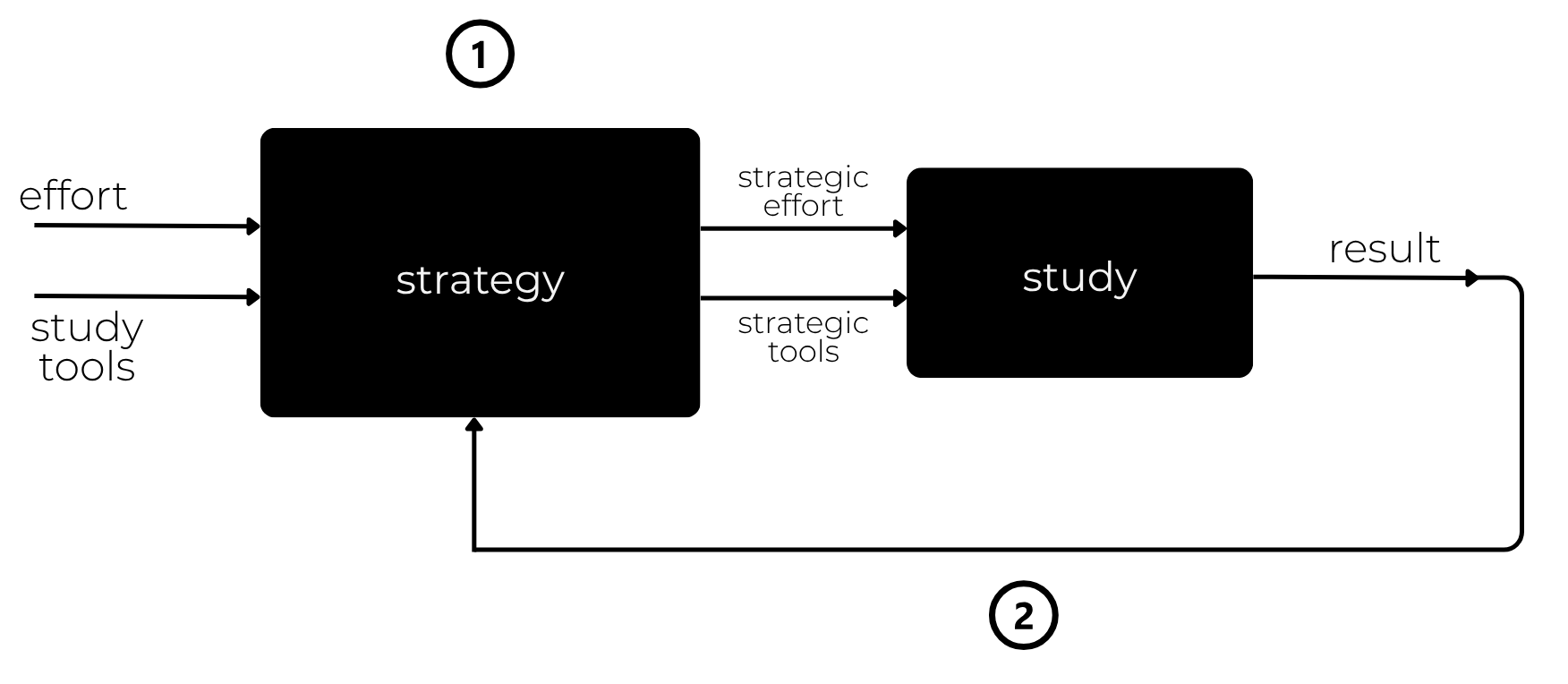
Research conducted by Barry Zimmerman[1] shows that high levels of achievement are not produced by straight line effort alone. Instead, effective learning develops through repeating cycles that allow improvement over time. To transform a straight line learning approach into a cyclic system, two important changes must be introduced.
2.1 Adding a Strategy Layer
The first change involves inserting a strategy layer between effort and study execution. In a straight line system, effort moves directly into study actions without careful planning. In contrast, when a strategy layer is introduced, effort is guided by deliberate decisions. This transforms raw effort into strategic effort.
Similarly, tools are no longer chosen randomly. Instead, they are selected based on clear goals, which converts random tools into strategic tools. This change ensures that learning actions are not based only on energy or motivation, but also on thoughtful preparation.
2.2 Adding Feedback to the System
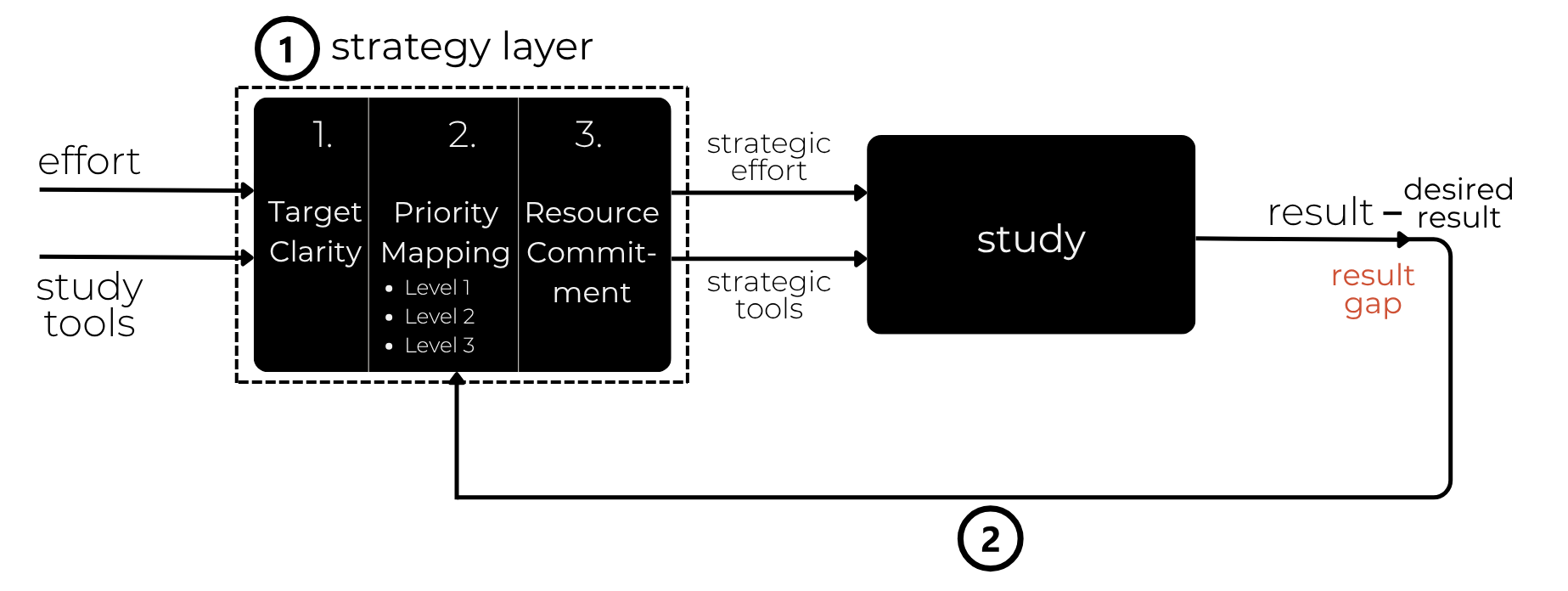
The second change involves connecting results back to the strategy layer through feedback. After each study cycle, learners compare their expected result with the actual result. The difference between these two values is your result gap. Information about this result gap is then returned to the strategy layer. Based on this information, adjustments are made. These adjustments influence how the next study session is performed. After the next session, results are measured again, and further adjustments are made if necessary.
Through repeated cycles of measurement and adjustment, the learning system becomes self correcting. Instead of increasing effort alone, learners improve their strategies over time. This gradual refinement reduces the result gap and increases the likelihood of achieving desired outcomes.
3. The Strategy Layer
The strategy layer contains three key steps that guide learning before study execution begins. These steps are derived from established principles in learning research and are simplified into a practical sequence that students can easily follow. The three steps are:
- Target Clarity
- Priority Mapping
- Resource Commitment
Each step builds on the previous one, creating a structured foundation for learning.
3.1 Step One: Target Clarity
Defining What Success Looks Like
Target clarity refers to defining success in a clear and measurable way. Many students begin studying with vague goals, such as wanting to perform well or improve understanding. While these intentions are positive, they lack the precision needed for effective planning.
Instead of vague goals, students should define precise targets that describe what achievement looks like.
For example, instead of stating:
"I want to do well in this course"A clearer target would be:
"I want to consistently score above 85 percent on weekly quizzes."
In this case, weekly quizzes serve as measurable checkpoints that help track progress over time. Another example can be seen in language learning.
A vague goal might state:
"I want to learn this language in six months."A clearer version would specify:
"In the next six months, I will memorize all required vocabulary and grammar points."
Once the total content is known, the target can be divided into smaller units. For instance, if a language contains 3000 vocabulary words and 100 grammar rules, these totals can be distributed across weeks. This division results in specific weekly targets, such as learning 125 words and 5 grammar rules each week. Students can also define rules for processing information. For example, a student might decide:
"Whenever I study a concept, I will explain it aloud as if teaching it to a ten year old."Such rules ensure that understanding is tested during learning rather than assumed.
Why Target Clarity Is Important
Clear targets provide several advantages. First, they allow large goals to be divided into smaller checkpoints. These checkpoints make progress visible and measurable. Second, measurable progress supports the development of feedback, which is necessary for improving learning strategies.
Another important factor involves understanding the reason behind a chosen target. When students clearly identify why a goal matters to them, their level of commitment increases. This increased commitment helps maintain persistence when difficulties arise.
3.2 Step Two: Priority Mapping
Organizing Time and Effort for Maximum Effect
Research in cognitive science shows that working memory has limited capacity. When too many tasks compete for attention, confusion increases and learning efficiency decreases. Organizing priorities reduces this confusion and frees mental resources for meaningful learning[2, 3].
Before selecting study methods, learners must decide how their time will be distributed. Daily life includes many responsibilities, such as sleep, school attendance, physical activity, travel, family interactions, and personal responsibilities. Priority mapping helps organize these responsibilities into structured levels. Priority mapping is divided into three levels.
Level One: Prioritizing Daily Life Activities
The first level focuses on daily habits that support mental and physical stability. These habits form the foundation of learning readiness.
For example, insufficient sleep can significantly reduce attention and memory performance. In such cases, increasing sleep should be prioritized before adding additional study hours. Similarly, emotional factors such as loneliness or worry may reduce concentration. Allocating time for meaningful social interaction may therefore improve learning effectiveness. Physical health also plays an important role.
For example, if prolonged sitting causes discomfort or pain, incorporating stretching or exercise into the daily routine may improve comfort and focus. The central idea is straightforward: When the body and mind are supported, learning becomes easier and more sustainable.
Level Two: Prioritizing How We Study
The second level focuses on deciding how studying should occur. Learning involves many possible actions, including attending lectures, solving practice problems, revising content, creating notes, completing assignments, preparing for tests, and so on. However, not all actions contribute equally to learning progress.
Students should ask a guiding question: Which study actions contribute most to reaching the defined target?
For example, spaced repetition techniques may provide stronger memory retention than decorative note making. Similarly, solving practice problems may strengthen understanding more effectively than repeated reading. If graded tests influence final results, preparation for those tests should receive higher priority.Level Three: Prioritizing What We Study
The third level focuses on determining what content deserves the greatest attention. In many academic settings, some topics carry more weight than others.
For example, students preparing for entrance examinations may benefit from prioritizing frequently tested topics. Students preparing for employment may focus more heavily on technical subjects valued by employers. Those attempting to improve academic grades may allocate additional time to subjects that contribute significantly to overall marks. When content priorities are clearly defined, study time is directed toward areas that produce the greatest improvement.
3.3 Step Three: Resource Commitment
In the modern learning environment, students have access to an enormous amount of information. Learning materials are available through books, video lectures, online courses, mobile applications, and educational websites. Because of this abundance, the main difficulty is no longer finding information. Instead, the challenge lies in selecting suitable resources and using them consistently.
Many students make the mistake of frequently switching between different learning resources. For example, a student may begin with one textbook, then move to a video series, later switch to another book, and continue this pattern repeatedly. Although this behavior appears productive, it creates hidden difficulties.
Each resource explains ideas in its own structure and style. When a learner switches resources, the brain must spend time adjusting to the new explanation method. This repeated adjustment interrupts the learning process and reduces efficiency. Instead of focusing on understanding the concept, the learner spends time rebuilding context.
For this reason, resource commitment is an important step in the strategy layer. Resource commitment involves two stages: selection and consistency. First, learners should spend a short period exploring different resources. During this stage, the goal is to identify materials that match three important conditions:
- The resource supports the defined learning target
- The difficulty level matches the learner’s current ability
- The explanation style is easy to understand
After selecting appropriate resources, the second stage begins. At this point, learners should commit to using the chosen resources consistently. Frequent switching should be avoided unless clear evidence shows that the resource is unsuitable.
Consistency allows the learner to build familiarity with the structure of the resource. Over time, this familiarity reduces confusion and increases the depth of understanding. Only when resources are used consistently can the learning system produce reliable results that can later be evaluated through feedback.
4. The Feedback Loop
After constructing the strategy layer, the next step involves testing whether the system works effectively. This testing process is carried out through a feedback loop.
During Step One, large goals were divided into smaller checkpoints. Each checkpoint represents a small unit of progress. When a learner reaches a checkpoint, one study cycle is completed. At the end of each study cycle, learners pause briefly and evaluate their progress by asking three guiding questions.
4.1 Three Core Feedback Questions
After completing each checkpoint, learners should ask:
- Did I get the result I wanted?
- Was the result worth the effort I put in?
- How did I feel during the study cycle?
These questions provide three different types of information.
- The first question measures performance accuracy. It helps identify whether the achieved result matches the planned target.
- The second question evaluates efficiency. It determines whether the time and energy invested produced reasonable benefits.
- The third question examines emotional sustainability. It identifies whether the learning process feels manageable or exhausting over time.
Together, these questions provide a balanced view of both academic progress and personal well being.
4.2 Interpreting Feedback Results
If the answers to the three questions indicate positive outcomes, learners may continue using the current strategy without major changes. However, if results do not match expectations, if effort produces weak returns, or if negative emotions appear frequently, adjustments must be made. These adjustments usually involve modifying one of the three components of the strategy layer:
- Target Clarity
- Priority Mapping
- Resource Commitment
The purpose of feedback is not to criticize performance, but to identify specific causes of difficulty and guide improvement. To simplify the feedback process, learners can use structured diagnostic tables. These tables help identify problems, locate their causes within the strategy layer, and suggest practical solutions.
I hope this inspires you to shape learning habits that are not only effective and efficient, but also sustainable in the long run. More than anything, I hope you learn to enjoy the journey itself. Feel free to message me with your thoughts. I’d love to hear your perspective. Happy learning!
Further Reading on Self Regulated Learning
- Zimmerman, B. J. (2002). Becoming a self regulated learner: An overview. Read here
- Panadero, Ernesto. (2017). A Review of Self Regulated Learning, Six Models and Four Directions for Research. Frontiers in Psychology, Volume 8, Article 422. Read here
- Kitsantas, A., Panadero, E., and colleagues (2025). Barry J. Zimmerman's Enduring Legacy. Read here