The Science of Learning Math: Strategies to Think Like an Expert
Discover why math feels so tough and learn four powerful strategies to transform yourself into a confident, efficient thinker.
We have all experienced that paralytic moment: staring at a complex mathematical problem that appears less like a logical challenge and more like an indecipherable ancient script. For a significant portion of the population, mathematics represents a formidable psychological barrier, often leading to a debilitating cycle of frustration known as “math anxiety.” However, cognitive science reveals a liberating truth: the human brain is inherently wired for logical processing and pattern recognition. The primary hurdle to mathematical proficiency is rarely a deficit in raw intelligence; rather, it is a fundamental misalignment in pedagogical approach and study methodology.
Mathematics is a unique discipline that demands a departure from the passive learning habits sufficient for subjects like history or literature. Mathematics is an intellectual sport; it requires active participation, vigorous practice, and the development of specific mental gymnastics. In this comprehensive guide, we will analyze the structural uniqueities of mathematics and provide four high-level strategies designed to transform your cognitive approach from one of struggle to one of mastery.
Why Mathematics Feels Uniquely Difficult
To navigate the complexities of mathematical study, one must first understand the cognitive load it imposes. There are three distinct structural characteristics that differentiate mathematics from nearly every other academic pursuit.
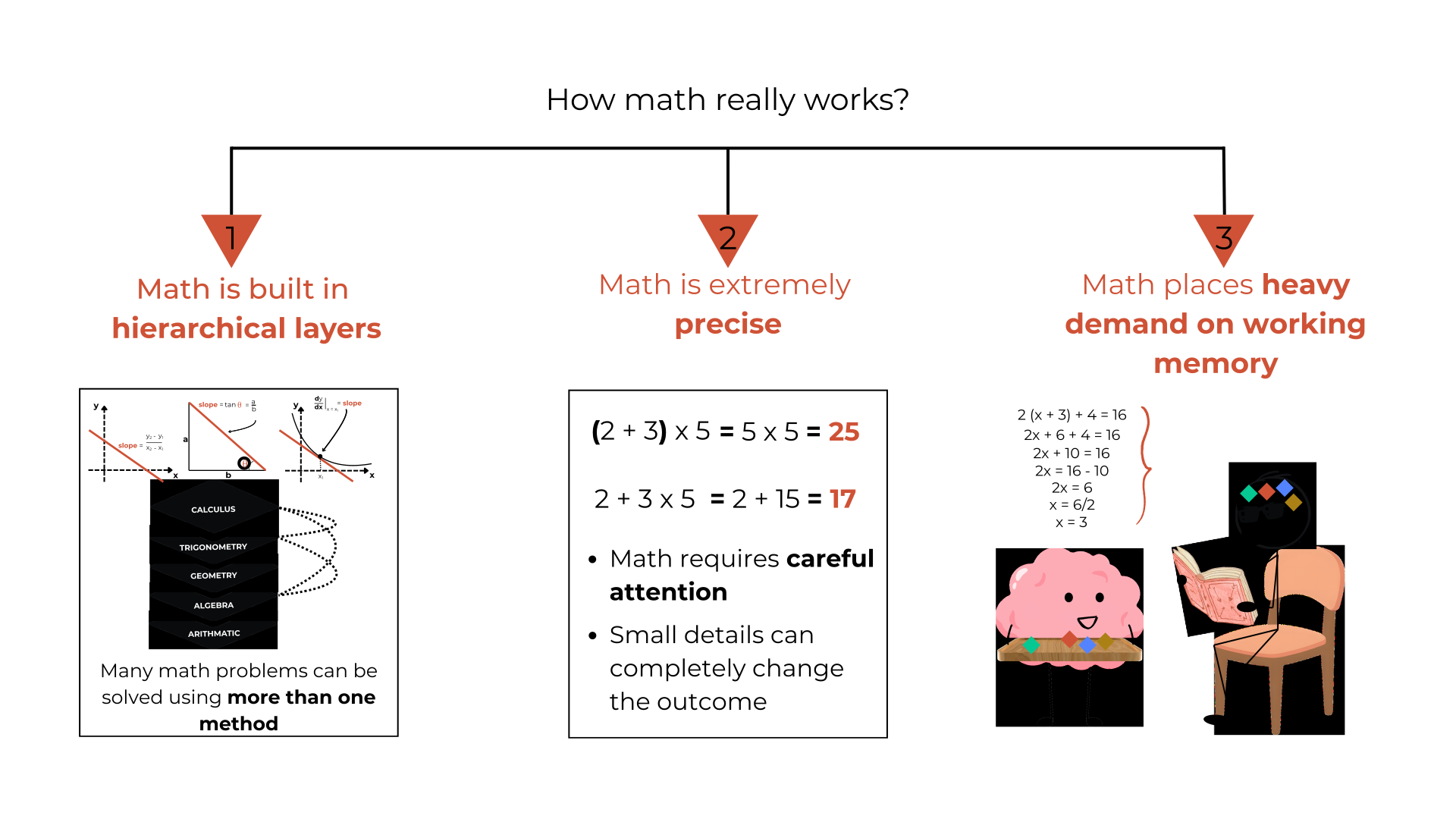
1. The Hierarchical layer
In disciplines like biology, knowledge is often modular; you can develop a sophisticated understanding of the cardiovascular system even if your knowledge of neurology is rudimentary. In mathematics, however, every concept serves as the essential foundation for the next. Level five is quite literally impossible to achieve without a robust level one.
For example, a student cannot meaningfully understand algebra without first becoming comfortable with arithmetic operations such as fractions, multiplication, and negative numbers. Later, calculus relies heavily on algebraic manipulation. If algebra feels unstable, calculus immediately becomes overwhelming, not because calculus itself is impossible, but because the foundation beneath it is weak.
2. The Precision
Mathematics is famously, and often ruthlessly, unforgiving. In a literature essay, a minor grammatical error or a misplaced comma rarely obscures the core argument. In mathematics, a single misplaced bracket or a forgotten negative sign in the second line of a three-page derivation can render the entire final result invalid. This “precision” demands a sustained level of “active attention” and meticulousness that is mentally exhausting. It requires the student to act as their own auditor, checking every step against the laws of logic in real-time.
3. The Working Memory Load
Working memory is the part of the mind responsible for temporarily holding and manipulating information while you think. It functions like a a limited mental workspace where your brain keeps track of ongoing steps, numbers, formulas, and logical relationships. Mathematics places an unusually high demand on this system. When solving a math problem, you rarely arrive at the answer in a single move. Instead, you progress through a chain of interconnected steps. To continue correctly, you must constantly remember what happened earlier in the process. Sometimes, a value calculated three or four steps before becomes essential later in the solution. As the number of steps increases, the pressure on working memory grows rapidly. This is why many students lose their flow in the middle of a problem, even when they understood the concept initially.
Therefore, to become good at mathematics, you need to keep the above three characteristics of mathematics in mind and follow this:
- Make sure that earlier concepts are clear before moving to new topics.
- Pay close attention to every symbol and every step instead of rushing through calculations.
- Practice enough to make basic operations automatic so that the load on your working memory is reduced. Through repetition, basic operations gradually become automatic. Tasks such as multiplication, fraction simplification, or algebraic manipulation stop consuming conscious mental effort. Once these lower-level processes become automatic, working memory is freed to focus on higher-level reasoning and problem-solving.
Strategies to Go Beyond “Being Good” at Mathematics
Once you build a solid foundation in basic mathematical thinking, the next stage is learning how to think more deeply and strategically about problems. At this level, progress no longer comes from memorizing formulas or repeatedly applying fixed procedures. Instead, it comes from developing intuition, recognizing hidden patterns, and learning how experienced problem-solvers approach mathematical ideas.
The following four strategies are designed to help you move from mechanical problem-solving toward genuine mathematical understanding. They will help you strengthen analytical thinking, improve pattern recognition, and approach complex problems with greater clarity, efficiency, and confidence.
Strategy 1: Build Schemas Instead of Memorizing Isolated Topics
We already saw that mathematics is built in layers, where the same fundamental ideas keep returning in more advanced forms. But most students study each topic separately and rarely stop to connect ideas across different areas of mathematics.
You study geometry, then graphs, then calculus. You understand each chapter individually, solve practice problems, and move on. But very few students pause to ask how these ideas are actually related to one another.
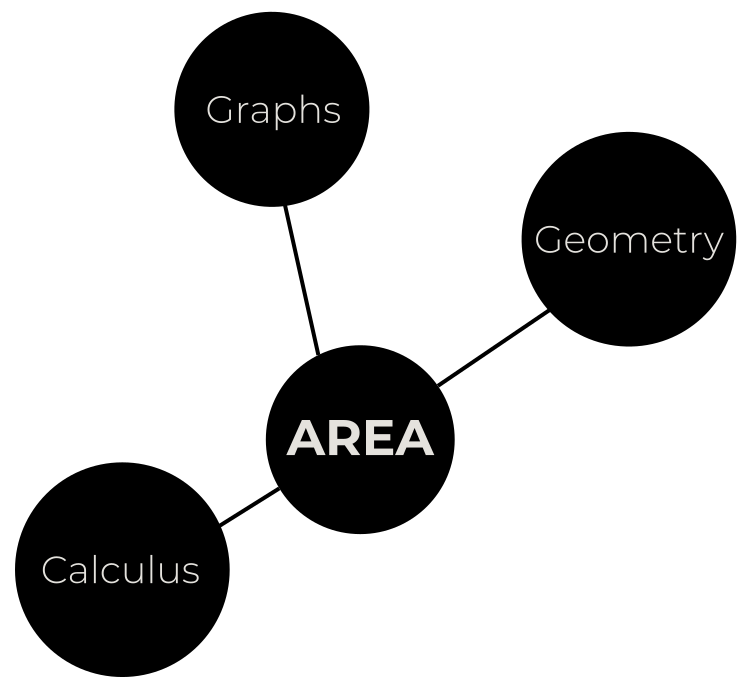
This is where schemas become important. A schema is a connected network of ideas that your brain builds to organize and relate concepts together. Instead of storing mathematical topics as separate pieces of information, your brain begins linking them into one larger system. When your schemas become stronger, your thinking becomes more flexible. You stop seeing only one method for solving a problem and begin recognizing multiple possible approaches. This is one of the biggest differences between average students and strong mathematical thinkers.
Let us understand this with a simple example. In geometry, you learn how to calculate the area of basic shapes such as rectangles, triangles, and circles. Later in calculus, you learn integration to calculate the area under curves that cannot be handled using simple geometric formulas. Now consider the following problem:
Find the area under the graph of:
For many students, the first instinct is: “This is a calculus problem. We should use integration.”
So they split the function into two parts, integrate from to , then from to , and eventually arrive at the correct answer after several steps:
But now pause for a moment and simply look at the graph:
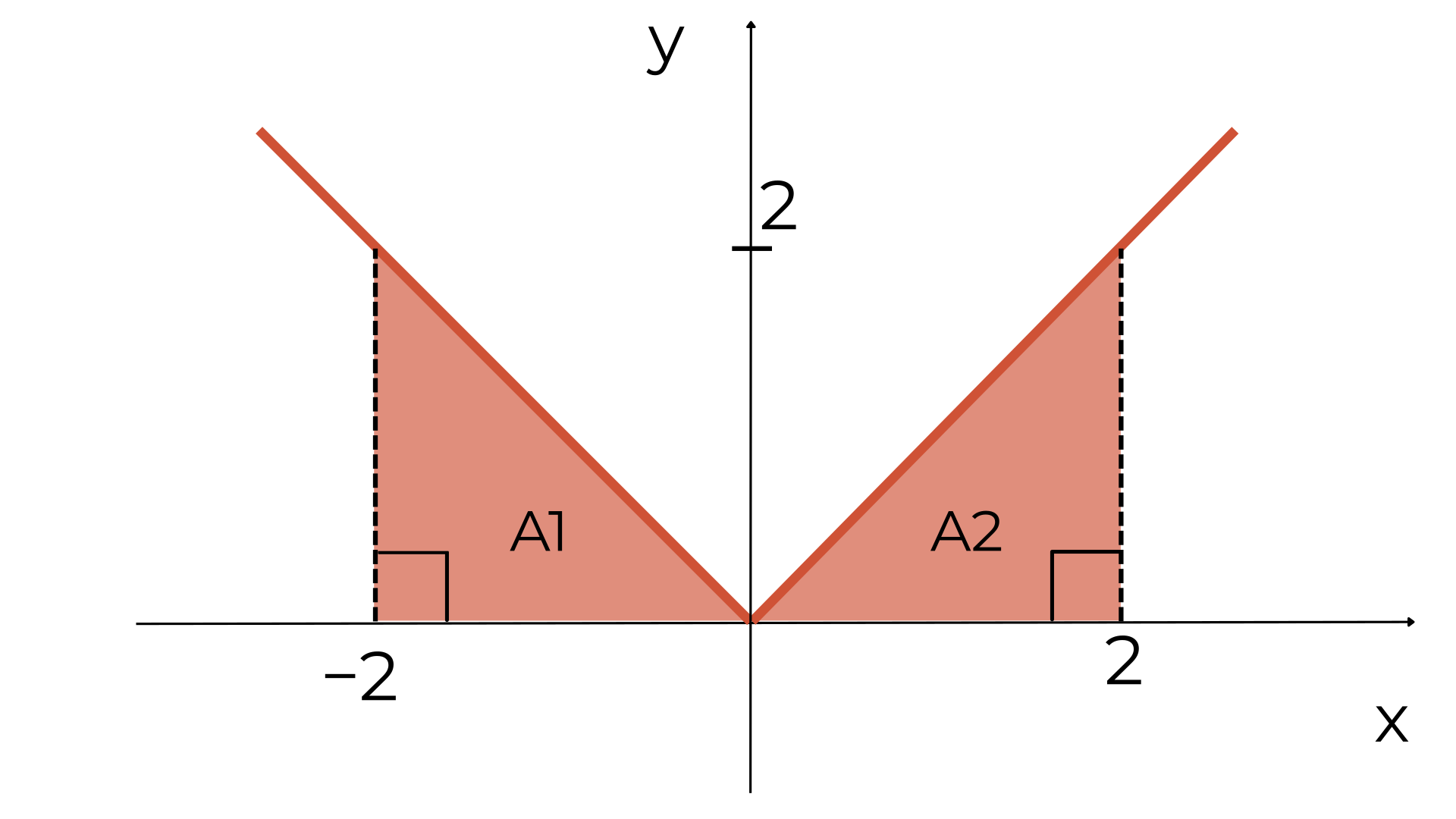
The graph of forms a simple V-shape. Between and , the region under the graph forms two identical right triangles. Instead of performing integration, you can directly calculate the area using the basic geometric formula for the area of a triangle. This approach takes only a few seconds:
One approach treated the question purely as a calculus problem. The other recognized the hidden geometric structure inside it. That ability comes from the schema your brain has built between geometry, graphs, and calculus. Because of that schema, your brain can shift between viewpoints and choose the simplest path instead of mechanically applying formulas. This is why building schemas is so important in mathematics. The more connected your knowledge becomes, the more naturally you begin recognizing patterns, simplifying problems, and discovering elegant solutions.
Actionable Advice:
Every time you encounter a new formula, perform a schema exercise.Explicitly ask:
"What existing concept does this remind me of?"  or

"How is this a more complex version of something I’ve already mastered?"
Strategy 2: Building Intuition
Mathematical intuition is the ability to look at a problem and develop a rough understanding of what is happening before performing detailed calculations. It helps you predict the structure of a solution instead of blindly applying formulas step by step. This skill develops when you compare problems that appear similar but contain small differences. Over time, your brain begins noticing patterns automatically. Let us understand this with a simple example involving the distance between two points.
The standard distance formula is:
Now consider these two problems:
1. Find the distance between points: (2, 3) and (7, 7)

2. Find the distance between points: (2, 3) and (7, 3)
At first glance, both problems seem like straightforward applications of the same formula. But now pause and compare them carefully. In the first problem, both the -coordinates and the -coordinates change. The line connecting the two points is diagonal, so using the full distance formula makes sense. In the second problem, however, the -coordinates are exactly the same. That means the two points lie on a horizontal line. Once you notice this, the problem becomes much simpler. You no longer need the entire formula; the distance is simply the difference between the -values.
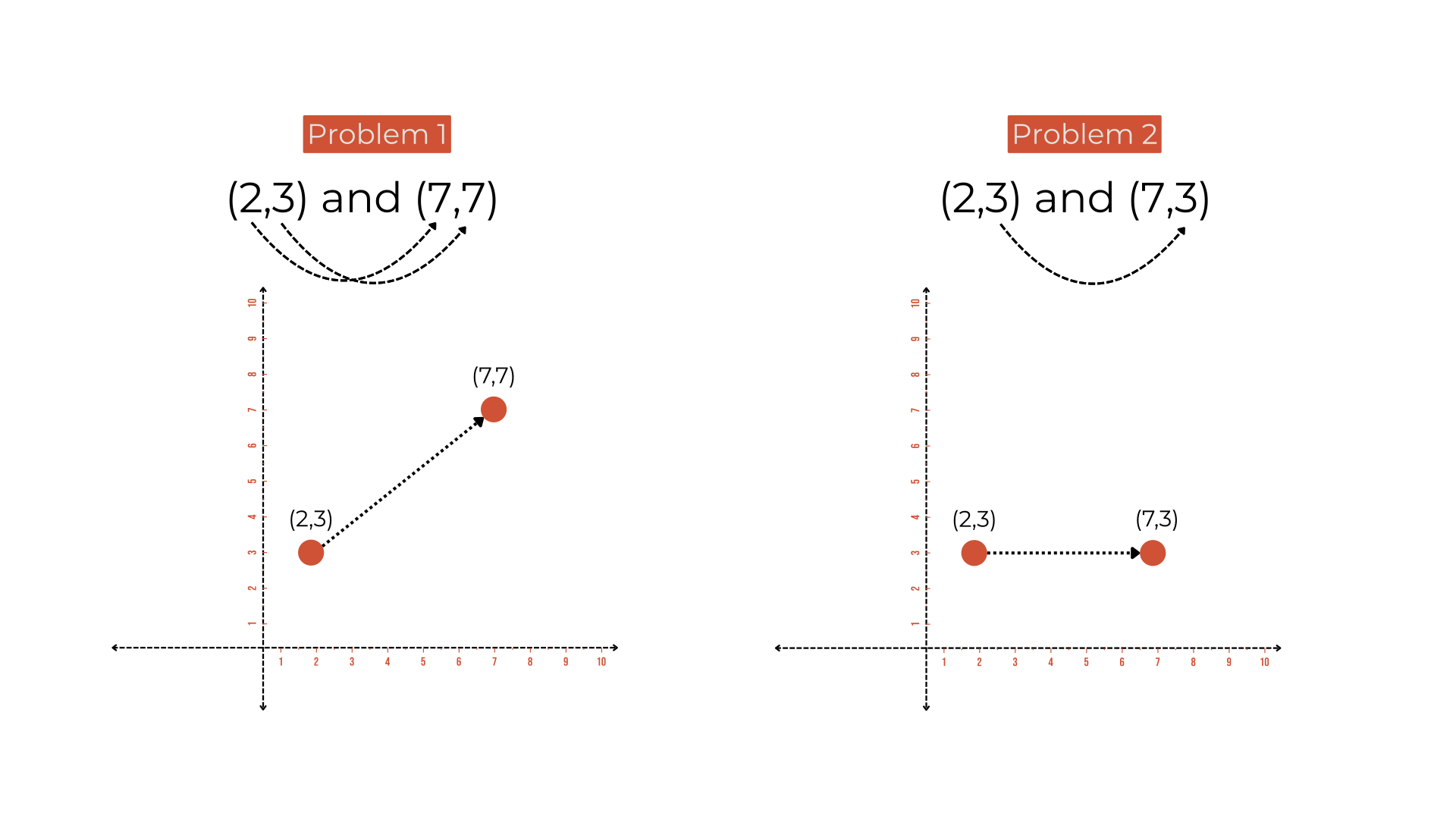
The important shift happens when you begin noticing these structural variations before calculating. That is how intuition develops. Instead of mechanically applying formulas to every problem, your brain starts recognizing patterns, predicting solution types, and identifying shortcuts naturally. Over time, this makes problem solving faster, clearer, and far less mentally exhausting.
Actionable Advice:
Practice side-by-side comparision.While solving similar problems, do not focus only on getting the final answer. Pause and carefully observe the small differences between the problems. Ask yourself what that variation actually changes in the structure of the problem, the logic of the solution, or the behavior of the equation. This habit gradually develops mathematical intuition and pattern recognition.
Strategy 3: Starting Slow to Solve Fast
Good math students can solve problems. Strong mathematical thinkers try to solve them with the least unnecessary effort. Knowing formulas is important, but even more important is knowing when to use a formula and whether there is a cleaner or simpler approach available.
Consider this problem:
Find the value of (48 X 52).One way to solve it is through direct multiplication, which would be very long. A stronger approach is to first look for hidden structure. The problem can be solved in fewer steps using hidden structure:
,
which matches the algebric identity .
This will give two step solution:
This is an important shift in mathematical thinking. Do not rush into calculations the moment you see numbers. They first pause and ask: “Is there a simpler pattern hidden inside this problem?”
Sometimes there will not be a shortcut, and that is perfectly fine. You can then solve the problem using the standard method. But developing the habit of briefly analyzing the structure before calculating trains your brain to think more strategically and efficiently.
Actionable Advice:
Implement a “No-Write Period.” While practicing problems, for the first few seconds do not allow yourself to write anything. Only look for shortcuts, estimate the answer, and plan your logical path.
Strategy 4: The “Postmortem” Analysis
Most students already do this when they get an answer wrong. They check the solution, identify the mistake, and practice the problem again. That is useful; but to develop the strong mathematical thinking do something extra: review your thinking even when the answer is correct. Why?
Because getting the correct answer does not always mean your thinking was efficient, flexible, or deeply understood. Sometimes you arrive at the correct answer using a very long method. Sometimes you solve the problem mechanically without noticing the hidden pattern behind it. And sometimes you become so comfortable with one approach that you stop recognizing alternative methods completely.
After solving a problem, pause and analyze how you solved it and why you chose that method. This process of thinking about your own thinking is called metacognition. It is one of the most powerful tools for deep learning.
Ask yourself questions like:
- Could this problem be solved in a cleaner way?
- Was there a faster or more elegant method?
- Did I actually understand the structure behind the solution?
- Could this be solved visually or through another concept?
- How would someone else approach the same problem?
These questions force the brain to reorganize and strengthen understanding instead of simply repeating procedures mechanically. Over time, this habit develops flexibility in thinking. You stop memorizing isolated methods and begin understanding the deeper logic behind mathematics itself.
Actionable Advice:
After solving important problems, spend a few minutes reviewing your solution process instead of immediately moving to the next question. Focus not only on whether the answer was correct, but also on whether your method was efficient, clear, and conceptually strong.
Final Thoughts
Math feels difficult for many people, but not always for the reasons they think. Most of the time, the problem is not a lack of intelligence. Mathematics simply demands a different way of learning. It builds layer by layer, requires careful thinking, and constantly asks your brain to connect ideas, remember steps, and notice patterns at the same time. That is why memorizing formulas alone never feels enough.
Real improvement begins when you stop treating math as a subject of procedures and start treating it as a way of thinking.
The four strategies discussed in this article are meant to help with exactly that:
- Building connections between ideas across different sections
- Developing intuition through comparison of small variations
- Looking for structure before solving a problem
- Reflecting on your thinking after solving a problem
At first, these habits may feel slow or unnatural. But over time, they completely change the way you approach mathematics. Problems start feeling less random. Patterns become easier to notice. And instead of depending only on memorization, you begin understanding why things work. Good mathematical thinkers are not people who instantly know every answer. They are usually people who pause, observe carefully, look for relationships, and learn something from every problem they solve. And that kind of thinking can absolutely be developed with time and practice.