Beat Procrastination With Science
Understand why procrastination isn't caused by a lack of self-control, and how a 4-factor psychological framework can help you change your habits.
Most people think procrastination is a self-control problem. They tell themselves they’ll start tomorrow, wait for motivation to arrive, and blame themselves when it never does. But what if procrastination isn’t random at all? What if it follows a predictable psychological formula?
Researchers at Griffith University Australia tested this idea in a fourteen-day experiment involving 107 first-year students of their psychology department. Instead of asking participants to “try harder” or become more disciplined, they used a simple system. Twice a day, students received short questions on their phones that interrupted their usual pattern of delaying work.
The results showed that students became less likely to procrastinate, even those who already had strong procrastination habits. The reason the intervention worked is simple: each reminder was designed to target one of the four psychological factors that drive procrastination.
In this article, you’ll learn what those four factors are, how researchers used them to reduce procrastination, and how you can build the same system into your own daily life.
1. The Experiment
Researchers called this system the LIHF (Low Intensity High Frequency) Intervention System. To test whether procrastination could be reduced without relying on motivation, researchers conducted an experiment with 107 college students who had an upcoming assignment deadline.
The students were randomly divided into two groups and observed for fourteen days leading up to the deadline. Both groups received the same text message twice a day:
“How much of your assignment have you completed?”
Each student had to report their progress. But there was one important difference.
One group received an additional question alongside the progress check. This extra question was not chosen at random. It was selected from four specific prompts that were carefully designed to target the four main psychological reasons people procrastinate.
These four reasons come from the Temporal Motivation Theory, a psychological model developed by Piers Steel and Cornelius König[1]. The theory explains motivation using a surprisingly simple equation:
At first glance, the formula might look intimidating. But the idea behind it is actually quite simple. According to the theory, your motivation depends on four psychological factors:
- Expectancy is how strongly you believe you can successfully complete the task.
- Value is how rewarding, meaningful, or enjoyable the task feels.
These two factors increase motivation. The more confident you are and the more valuable the task feels, the more likely you are to start working.
The other two factors work in the opposite direction:
- Delay refers to how far away the reward or deadline is. The farther away it feels, the less motivated you become.
- Impulsivity is your tendency to choose immediate distractions over long-term goals. The easier it is to get pulled toward your phone, social media, or entertainment, the harder it becomes to stay focused.
Together, these four factors determine how likely you are to take action or procrastinate. Instead of trying to increase motivation directly, researchers designed four prompts to influence these four factors. By repeatedly interrupting students with these carefully crafted questions, they aimed to reduce procrastination before it became a habit.
The intervention was low intensity because it didn’t ask students to spend hours in workshops, attend coaching sessions, or completely change their routines. Instead, it consisted of a few short questions that took less than a minute to answer.
At the same time, it was high frequency because these questions appeared repeatedly. Students received them twice a day for fourteen consecutive days. Rather than trying to create one big moment of motivation, the researchers relied on many small interruptions spread across time.
This idea is important because procrastination is rarely a one-time decision. Every day, and often several times a day, we face moments when we choose between working on an important task or doing something easier and more immediately rewarding.
The researchers believed that if they could interrupt these moments before procrastination took over, they could gradually change students’ behavior.
2. Reasons of Procrastination
There are four major factors that influence procrastination. Let’s understand each factor one by one.
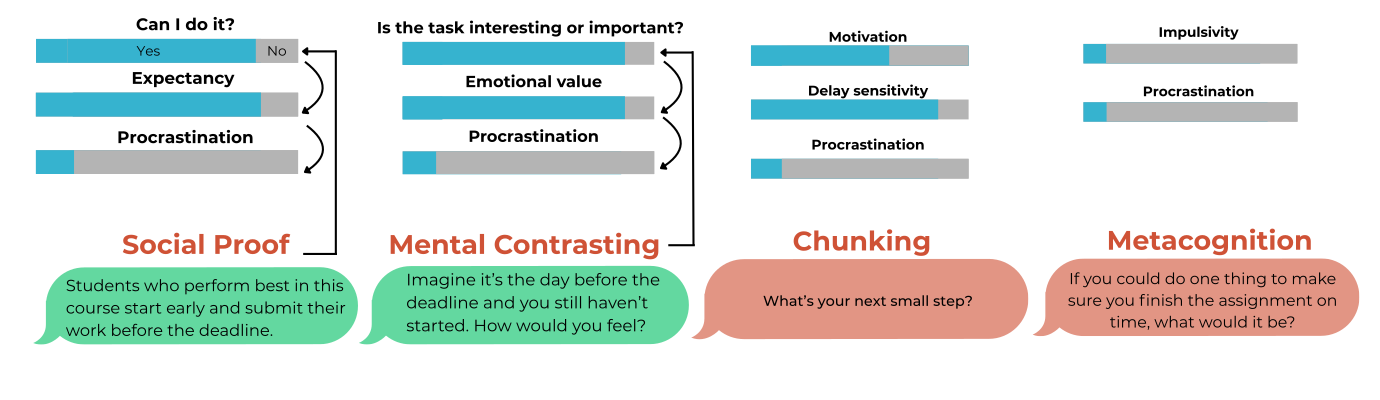
Expectancy
Do I believe I can actually do this?
Expectancy is your belief that you can successfully complete a task. Think about the last time you postponed something because it felt too difficult. Maybe it was writing a report, learning a new skill, or starting a large project. Often, the problem isn’t that the task is impossible, it’s that your brain predicts failure before you’ve even started.
Low expectancy drops your motivation to complete the task. Such task feels overwhelming, and choice to avoide it feels easier to our brain.
Researchers wanted to increase students’ expectancy by using a psychological principle called social proof. Instead of telling students to be more confident, they reminded them that successful students in the same course were not fundamentally different: they simply started earlier and consistently worked before the deadline.
Social-Proof works because our brains constantly judge what is possible by observing people who seem similar to us. Seeing others succeed changes our expectation of our own success. The more achievable a task feels, the easier it becomes to begin.
Value
Is this worth doing?
Value is not about how useful a task is objectively. It’s about how rewarding or meaningful it feels to you in the moment.
This explains why people often avoid studying for an important exam while spending hours watching videos online. Passing the exam may be far more important, but the immediate emotional reward of entertainment feels stronger. The motivation declines when a task feels boring, repetitive, or emotionally distant.
To increase value, the researchers used a technique called mental contrasting.
Students were asked to imagine what would happen if they kept delaying their assignment. Questions encouraged them to picture the stress, guilt, regret, and anxiety they would experience if they reached the day before the deadline without making progress.
This shifts attention from the discomfort of working today to the much greater discomfort of delaying. As future consequences become more vivid, the task begins to feel emotionally important, making it easier to start.
Delay
Why do it now?
Even when a task feels important, another problem appears: the reward often seems too far away.
Humans naturally discount rewards that are distant in time. A deadline that is weeks away feels psychologically less important than a notification on your phone that demands attention right now.
This is the reason why you feel very motivated the night before a deadline. The reward hasn’t changed; the distance to the reward has simply become much shorter.
Instead of trying to make students care about a distant deadline, the researchers reduced the psychological distance by asking a simple question:
What’s your next small step?
This shifted attention away from the entire assignment and toward a single action that could be completed immediately.
Rather than thinking about writing an entire paper, students only had to think about opening the document, writing the introduction, or finding one source. Breaking large tasks into smaller actions makes progress feel immediate, reducing the effect of delay on motivation.
Impulsivity
Can I resist distractions?
Impulsivity is the tendency to choose immediate rewards over larger future rewards.
Imagine sitting down to work. Your phone lights up. Without thinking, you check one notification. A few minutes later, you’re scrolling through social media and an hour disappears.
Nothing about your goals has changed. What changed is that an immediate reward became available. The higher your impulsivity, the more likely you are to choose short-term pleasure instead of long-term progress.
To reduce impulsivity, researchers used metacognitive reflection, which simply means thinking about your own thinking. Students answered questions such as:
“If you could do one thing to ensure you finish the assignment on time, what would it be?”
This forced them to pause before acting automatically. Instead of following the impulse to procrastinate, they became aware of their own habits, obstacles, and decisions. That brief moment of reflection interrupted automatic behavior and made deliberate action much more likely.
Putting It All Together
These four factors explain why procrastination looks different from one person to another:
- Someone with low expectancy may avoid work because they doubt their ability.
- Someone with low value may simply find the task boring.
- Someone affected by delay keeps waiting until the deadline feels close.
- Someone with high impulsivity gets pulled away by every distraction.
Most people experience a combination of these factors rather than just one.
That’s why the researchers didn’t rely on a single intervention. They repeatedly interrupted students with prompts that targeted all four psychological drivers of procrastination. Over time, these small interruptions helped students make better decisions before avoidance had a chance to take over.
3. Build Your Own LIHF Intervention System
The students in the experiment had one big advantage: they had researchers who repeatedly interrupted their thinking with questions designed to counter procrastination before it took over.
Most of us don’t have someone checking in twice a day, but we can create the same system ourselves. The goal isn’t to force yourself to work; it’s to make sure the solutions appear in your mind before procrastination becomes the default response.
There are two ways to do this: external reminders and internal reminders.
External Reminders
External reminders are cues outside your mind that repeatedly bring your attention back to the task. These can be sticky notes, phone notifications, calendar reminders, browser extensions, wallpapers, or even objects left in plain sight.
The important part isn’t the format; it’s the repetition. Every reminder is an opportunity to stop procrastination before it becomes automatic.
Here’s how to connect each reminder to one of the four psychological factors:
1. Build Expectancy with Social Proof
If you often think, “I can’t do this,” surround yourself with evidence that you can. Save stories, videos, articles, or screenshots of people who have successfully completed the kind of work you’re trying to do.
Even better, collect evidence from your own life: write down projects you’ve finished, compliments you’ve received, or challenges you’ve overcome. Place these reminders where you’ll see them regularly.
The message you’re reinforcing is simple:
“People like me have done this before.”
or
“I’ve done difficult things before. I can do this too.”
Over time, these reminders make intimidating tasks feel more achievable.
2. Increase Value with Mental Contrasting
When a task feels boring, remind yourself why delaying it will feel worse. Write questions such as:
“How will I feel if I still haven’t started next week?”
“What problems will this create if I keep avoiding it?”
Whenever the reminder appears, spend a few seconds imagining the consequences: picture the stress, the guilt, the last-minute panic. Making these future consequences feel more immediate increases the emotional value of taking action today.
3. Reduce Delay with Chunking
Large projects naturally encourage procrastination. Instead of reminding yourself to finish an entire project, remind yourself of only the next action:
Not: “Finish the report.”
Instead:
“Open the document.”
or
“Write the introduction.”
or
“Read pages 50 through 80.”
Once that step is complete, replace the reminder with the next one. When your brain only sees one small action, getting started becomes much easier.
4. Reduce Impulsivity with Metacognitive Reflection
If distractions are your biggest challenge, make the interruption happen exactly when you’re about to get distracted.
One way to do this is by using an app such as ScreenZen[2]. Set a daily limit for distracting apps and add a waiting period before they open. Then use the custom message feature to display one of your reflection questions, for example:
- “What’s stopping me from working right now?”
- “What would move this task forward today?”
- “What would my future self want me to do?”
Each time you try to open a distracting app, you’re forced to pause before acting automatically. That brief interruption gives your rational mind a chance to catch up with your impulse.
You won’t resist every distraction, and you don’t have to. The goal is simply to increase the number of moments where you consciously choose instead of reacting automatically.
Internal Reminders
External reminders aren’t the only way to interrupt procrastination. Your brain can become the reminder itself.
This idea comes from the Zeigarnik Effect[3], a psychological phenomenon showing that unfinished tasks remain active in our minds. An incomplete task creates an open mental loop that your brain naturally wants to close.
You can use this to your advantage: whenever a task you’ve been avoiding comes to mind, don’t promise yourself you’ll finish it. Just work on it for five minutes. That’s enough.
Once you’ve started, stop if you want. The important part is creating the open loop. After you’ve begun, your brain is far more likely to keep bringing the task back into your awareness throughout the day. The next time it comes to mind, work for another five minutes, then another. Over time, those short sessions often become much longer without requiring a huge burst of motivation.
Further Readings
- Steel, P., & König, C. J. (2006). Integrating theories of motivation. Academy of Management Review, 31(4), 889–913. Read paper
- ScreenZen - Screen Time Limiter & Website Blocker. Visit website
- The Zeigarnik Effect Read